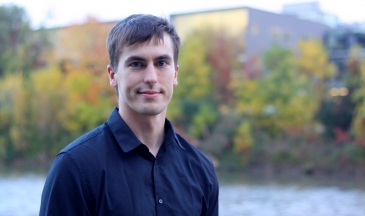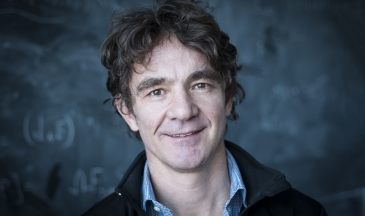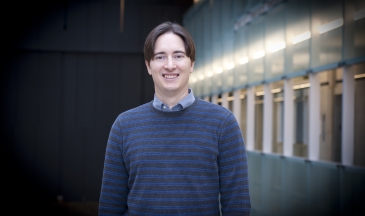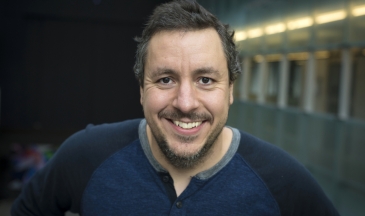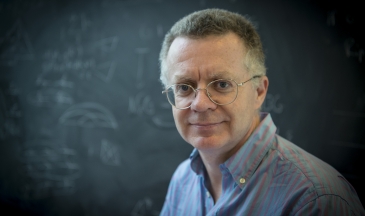
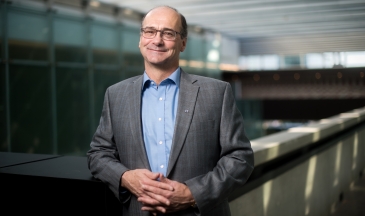
I am a gravitational wave astronomer. My research focuses on detecting gravitational waves emitted by coalescing compact objects with the Laser Interferometric Gravitational-wave Observatory (LIGO). My collaborator at the Canadian Institute for Theoretical Astrophysics (CITA), Kipp Cannon, and I represent PI and CITA as members of the LIGO Scientific Collaboration (LSC). We are both preparing for what our field colloquially calls the advanced detector era when the LIGO detectors will see a factor of 10 improvement in their sensitivity allowing gravitational wave detection to become routine.
Gravitational waves are predicted by Einstein's theory of General Relativity, though none have been directly detected. The reason that the direct detection of gravitational waves has escaped us for so long is that they have very little measurable effect on normal objects around us. The LIGO detectors are capable of measuring distances far smaller than the nucleus of an atom. We have no means to create gravitational waves of sufficient strength on earth and must instead look to the sky for some of the Universe's most extraordinary events.